Alvin Roth
The Plot Against AmericaAlvin Roth, Philip’s orphaned cousin and one-time ward of the Roth family, moves through the novel’s political upheaval by resisting the futures other people arrange for him. He rejects a sponsored education and career in Newark’s building trade to fight Nazi Germany with the Canadian Armed Forces; the choice costs him his left leg, but rehabilitation brings him back to civilian life. In the United States, however, his service does not secure uncomplicated belonging: his opposition to the Lindbergh administration makes him vulnerable to suspicion, intimidation, and expulsion.
Identity and early life
Alvin’s father, Herman Roth’s oldest brother, died when Alvin was six. His mother died when he was thirteen, and he came to live with Herman and Bess Roth during the four years he attended Weequahic High. By the time he left for Canada, he had been the family’s ward for close to seven years. Philip remembers him as quick-witted, prone to gambling and stealing, and the object of Herman’s determination to set him on a better course. This history makes their later arguments more than disagreements between an employer and a young worker: Herman has helped raise Alvin and sees his choices as a responsibility he cannot simply set aside.
In 1940, at twenty-one, Alvin rented a furnished room above a Wright Street shoeshine parlor and had worked for almost two years at Steinheim & Sons, one of Newark’s largest Jewish construction firms. He had entered the company through Abe Steinheim, whose business was also an insurance customer of Herman’s. At a Yom Kippur service, Abe had mistaken Alvin for Philip’s older brother, asked what the boy did, and offered him a job. He took a liking to Alvin’s solid build and self-assured manner, making him his driver rather than assigning him routine office work. Alvin carried messages, ran errands, and drove Abe between construction sites as he checked on subcontractors. The position brought Alvin close to the workings of a powerful business—and to the labor practices he came to despise.
A future refused
Abe’s investment in Alvin eventually extended beyond employment. He arranged to send him to Rutgers University and pressed the university president for a full scholarship, arguing that Alvin was an orphan with unusual potential. Abe promised to build a college building, but insisted that Alvin be admitted and educated at no expense to himself. He expected Alvin to return in the summers as his driver and, after graduating Phi Beta Kappa, to sit down with him and discuss a place in the company. The offer was both an extraordinary opportunity and a path into lasting obligation.
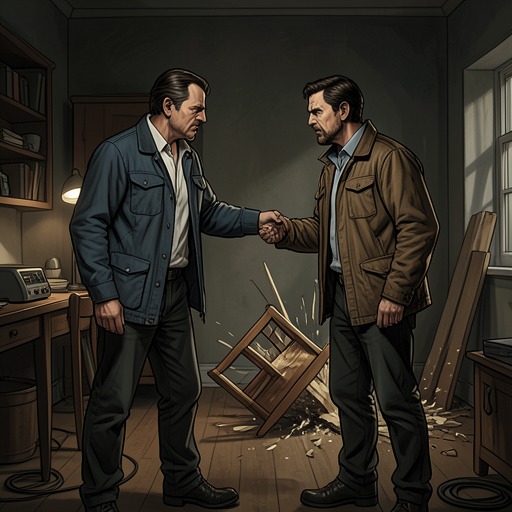
Alvin objected to what he saw as the bargain’s moral cost. He complained that Abe profited by taking advantage of workers, and that a free education would leave him indebted to a man whose business practices he rejected. Herman called these objections immature and countered that the building trade was cutthroat, that Abe’s buildings did not collapse, and that the opportunity mattered for Alvin’s future. Their dispute sharpened when Alvin distinguished between working for a Jewish builder and fighting Adolf Hitler: Herman saw a chance at education and security, while Alvin believed that serving Abe would compromise his principles. In February, rather than begin the planned course at Rutgers University, Alvin secretly took the express train from Newark Penn Station to Montreal. He had already said he would go to Canada and fight on the British side; now he acted on that resolve, leaving Herman furious and the family without advance notice.
From Canada to the front
Alvin first imagined joining a Canadian destroyer protecting supply ships bound for Britain. News reports of German submarines sinking Canadian vessels made that prospect seem immediate, especially after the Lindbergh administration overturned aid legislation passed under Franklin D. Roosevelt. In Montreal, however, an American volunteer described the Canadian commandos’ night raids in Nazi-occupied Europe: sabotage of utilities, destruction of ammunition stores, and attacks on docks and shipyards alongside British commandos and European resistance movements. After hearing how the commandos trained to kill, Alvin abandoned his original plan and enlisted in a commando unit.
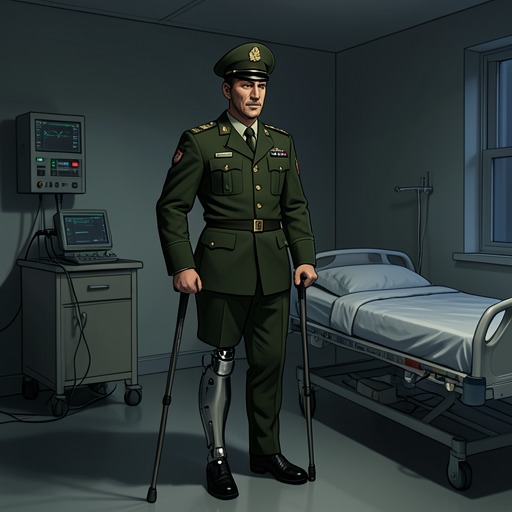
The Canadian Armed Forces accepted qualified American volunteers. Alvin completed sixteen weeks of training, joined an active unit, and was sent to a secret staging area in the British Isles. The family eventually received a brief letter from him saying he was off to fight and would see them soon. A later letter from the War Department in Ottawa reported that he had been wounded in action and was in a convalescent hospital in Dorset, England. The senior nurse on his unit wrote that he was not communicative. His left leg had been lost below the knee, and his right foot was seriously wounded, though it was healing without an expected lasting impairment. When his left leg was ready, he would be fitted with a prosthesis and taught to walk with it.
At a family dinner, Lionel Bengelsdorf used Alvin’s injury to argue that the United States had no reason to enter the war: Alvin, he said, had sacrificed a limb in a conflict unrelated to American security. Philip, hearing that Alvin was expected to return to the Roth household to convalesce, experienced the news not as a political abstraction but as the arrival of a changed life in a crowded home. His confusion over the family’s celebrated guest and the cousin who had fought Hitler turns Alvin’s injury into a direct measure of the distance between public arguments about neutrality and their private consequences.
The wound and its aftermath
Alvin’s later account strips away the neatness of a heroic story. Near dawn, while alone in no man’s land and waiting for a boat, he crawled roughly fifty yards toward a man who had been screaming through the night. The man was already dead. Alvin shot him twice in the head and spat on him; at that moment a grenade exploded. It struck both of Alvin’s legs. One foot was broken and twisted but could be repaired; the left leg was already nearly severed. Monty Roth suggested that the grenade might have come from one of Alvin’s own men, panicked in the half-light, but the account leaves this as a possibility rather than a settled explanation. Philip recognizes that the scene is nothing like the uncomplicated heroic reality he had imagined.
Alvin was discharged in January 1942. During a long rehabilitation, Canadian army nurses helped him move from a wheelchair to crutches and then learn to walk unaided on his artificial limb. The Canadian government granted him a monthly disability pension of $125, a little more than half of Herman’s monthly earnings from the Metropolitan, as well as $300 in separation pay. As a disabled veteran, Alvin could claim further benefits by staying in Canada; foreign volunteers were granted citizenship upon discharge if they wished to remain. Monty challenged him to become a Canadian and stay there, drawing on Alvin’s outspoken dissatisfaction with the United States. The choice remained open, but Alvin instead returned to his family and tried to resume work.
Return to Newark and renewed displacement
Back in Newark, Alvin took a menial job at Monty’s produce market. He did not last long enough to advance beyond sweeping and fetching. After little more than a week, the FBI questioned workers about him, insinuating that he was a self-declared traitor plotting to assassinate President Charles A. Lindbergh with anti-American malcontents. The allegation was ludicrous, but the questioning had an immediate consequence: Alvin was fired and told not to return to the market.
When Herman demanded an explanation, Monty said he had been ordered to get rid of his nephew by Longy Zwillman’s men. Longy’s organization controlled rackets ranging from bookmaking and strikebreaking to the trucking and hauling services imposed on merchants. With federal scrutiny a danger to the organization, Alvin’s presence had become a liability. He cleared out of the Roth home and left Newark in less than twenty-four hours, this time crossing the Delaware River to Philadelphia rather than the international border. He went to work for Shushy’s uncle, a gambling-machine operator who was apparently more tolerant of a man labeled a traitor than Newark’s powerful racketeers were.
Narrative significance
Alvin’s path joins private family loyalty to the novel’s larger conflict over American neutrality and dissent. Herman’s offer of education promises stability but asks Alvin to accept dependence on a businessman whose conduct he condemns; Alvin’s departure offers a way to act on his convictions, but not a clean escape from coercion. He returns wounded, having learned to walk on a prosthesis, only to encounter suspicion backed first by federal questioning and then by criminal power. His disability is rendered through practical details—hospital communication, treatment of the right foot, rehabilitation, a pension, and the ordinary work he attempts—while remaining inseparable from the political forces shaping where he can live and work. The result is a trajectory in which survival and resolve do not restore the life he left: each return brings another limit on his freedom to choose his own place in the world.